
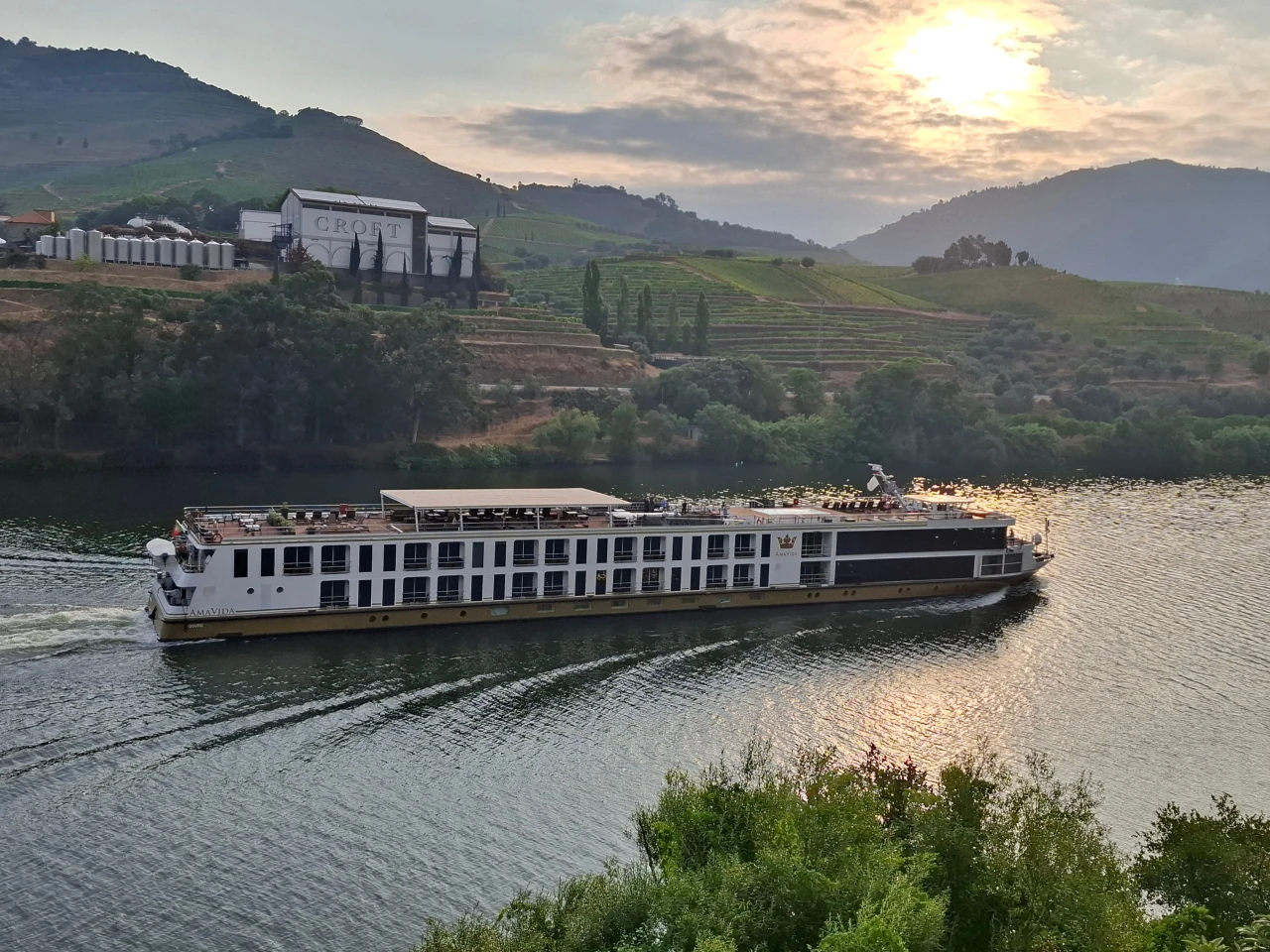
Douro River Cruises: Types of Trip, Departures and How to Choose
The Douro River is navigable from Porto to Barca d'Alva, next to the Spanish border, thanks to a series of dams with locks. According to Wikipedia, the waterway was opened along its whole length in 1990, and today it carries the pleasure boats that cross the Alto Douro wine region, a UNESCO World Heritage Site since 2001.
The choice is wide, from a trip of about an hour on a rabelo boat to multi-day programmes on a hotel ship. This page explains the kinds of cruise, where they depart from, what the locks are, when it is worth going and what to check before you book. We do not quote prices or timetables, because they change with the season, the route and what is included; please always check the operator's own website.
What kinds of cruise are there
The operator websites we consulted (for example Douro Azul and Rota do Douro) generally organise their offer into the categories below. Durations and timetables vary from operator to operator and from year to year.
Short trips of about 1 to 2 hours
In Porto and Vila Nova de Gaia there are trips under the city's bridges (one operator gives about 50 minutes). At Régua, one operator advertises a trip of about 50 minutes on a rabelo boat, returning to the same quay; at Pinhão, another offers a 2-hour rabelo trip to the mouth of the Tua River, again returning to the starting point. These suit visitors who are already in the Douro and want a first impression of the valley without giving up a whole day.
Half-day and full-day cruises
The most common routes are Porto–Régua–Porto, Porto–Pinhão–Porto, Régua–Pinhão, Régua–Pocinho and Régua–Barca d'Alva, among others. Some operators offer the trip upriver in one direction and the return by another means: for example, the half-day Régua–Pinhão route (about 2 h 15 min according to one operator) ends at Pinhão, and there are Régua–Porto programmes with a return by coach. There are also versions with lunch on board, with a visit to a wine estate or to cellars. Always check which of these extras are included in the ticket you choose.
Programmes of two days or more
Operators advertise 2-day and 3-day programmes, with a hotel-ship option and, in some cases, a stay at a Douro wine estate; Douro Azul also mentions hotel ships for longer voyages. Several itineraries include visits to wine estates. The number of nights and the accommodation (on board or ashore) depend on the programme, so read the full itinerary before you decide.
Private boats and smaller vessels
Some operators make yachts and rabelo boats available for private or group hire, including private and corporate events. Conditions and availability must be requested directly from the operator.
Where they depart from and which stretch of the river they cover
According to an operator's guide, the main boarding points are Porto and Vila Nova de Gaia, Régua, Pinhão, Pocinho and Barca d'Alva. Visitors based in Porto or Vila Nova de Gaia will find the bridge trips and the full-day cruises; those staying in Peso da Régua have the Régua Quay as the starting point for routes to Pinhão, Pocinho and Barca d'Alva. On the page for the city of Porto you will find what to see before or after your cruise.
As for the landscape, Wikipedia describes the Cima Corgo as the sub-region centred on the village of Pinhão, and the Douro Superior as the one that extends to the Spanish border. One operator points out, for example, that the Pinhão–Tua route cannot be seen from the national roads. Along the river you will also find the Cachão da Valeira, associated with the old difficulties of navigating the Douro.
An operator's guide points out that one day is not enough to cover the whole length of the river, which is about 200 kilometres.
The locks: what they are and what to expect
A lock is a chamber closed by gates into which the boat sails to be raised or lowered, so as to overcome the difference in level between the two sides of a dam. Between Porto and Barca d'Alva, the Douro waterway has five locks on Portuguese territory: Crestuma-Lever, Carrapatelo, Régua, Valeira and Pocinho (from the mouth upstream). The Pocinho lock, next to the Pocinho Dam, is the furthest upstream of the five.
According to Wikipedia, the Carrapatelo lock has a maximum lift of about 35 metres, the highest of the five. One operator states that the trip between Régua and Barca d'Alva passes through three dams (Régua, Valeira and Pocinho), and another describes the locks as one of the moments passengers remember most, especially going upriver.
Several operators state that certain cruises run only for part of the year (for example, from April or May to October) because of dam maintenance and weather conditions.
The rabelo boat
The rabelo was the traditional boat that carried barrels of wine from the Alto Douro to the cellars of Vila Nova de Gaia. According to Wikipedia, it was a flat-bottomed boat with no keel and a square sail, and it lost its leading role after the railway reached the Douro in 1887; by 1961 only six remained in regular use. Today rabelos take part in Porto's São João regatta and serve as excursion boats. Find out more in the history of the rabelo boats and the article on the rapids of the Cachão da Valeira.
When to go
An operator's guide says the regular season runs from mid-March to the end of the year and that, outside it, only short local trips run because the locks are closed. At the same time, some operators state that certain cruises run only from April or May to October, and one operator advertises a trip that runs all year round. As this information differs, please confirm the dates for your specific route on the operator's website.
Weekends are busier than weekdays, according to the same guide. If you would like to see the river during the grape harvest, read our article on the grape-harvest cruise on the Douro and book early.
Boat and train: possible combinations
The Douro Line runs from Ermesinde to Pocinho along the river (about 160 km, according to Wikipedia), with stations at Régua and Pinhão, and is operated by CP. Some cruises make use of this link: one operator offers, for example, a day with the train from Porto to Régua, a boat to Barca d'Alva and the train back to Porto; others return by coach. You can also combine them yourself: upriver by boat and back by train, or the reverse. Régua Station and Pinhão Station (known for its azulejo panels) are useful landmarks. See also our articles on visiting the Douro without a car and on a day trip from Porto to the Douro.
What to check before you book
- Boarding and disembarking point: check the exact quay and whether the boat returns to the same place.
- Route and direction: upriver, downriver or round trip, and how far the boat goes.
- Duration and times: departure and arrival times, and whether lock time is included.
- Return: whether the return transport (train or coach) is included and when it leaves.
- What is included: meals, drinks, estate visits, wine tastings and audio guides.
- Minimum number of participants: some trips only go ahead with a minimum number of passengers; ask how and when the departure is confirmed.
- Language: in which languages the information on board is given.
- Type of boat: rabelo, hotel ship, yacht or excursion boat, and the conditions on board.
- Accessibility: if you have reduced mobility or travel with a pushchair, ask the operator before buying.
- Cancellation and changes: the terms in case of bad weather, dam maintenance or withdrawal.
- Season: confirm that the route you want runs on your date.
Frequently asked questions
How much does a Douro cruise cost?
It depends on the route, the duration, the type of boat and what is included, and it varies greatly between a short trip and a multi-day programme. Because prices change, we do not publish them here: check the current price on the operator's website and compare what is included.
How long does it last?
It varies a great deal. One operator gives about 50 minutes for a rabelo trip at Régua, 2 hours for the Pinhão–Tua trip and about 2 h 15 min for the Régua–Pinhão trip upriver, and there are full-day cruises and multi-day programmes. These figures are what the operators stated at the time we checked; always confirm with yours.
Can I do the cruise in one direction only?
Yes, some operators offer the trip upriver or downriver, with a return by train or coach in other programmes.
Do the cruises run all year round?
Not all of them. There are indications of a regular season from mid-March to the end of the year, and of cruises that run only from April or May to October; one operator says a specific trip runs all year. Always check the date you want.
Do I need to book in advance?
It is wise, especially at weekends, during the grape harvest and for multi-day programmes. Some trips only depart with a minimum number of participants, so confirm your booking with the operator.