What to Do in Lamego, Portugal: Complete Douro Guide

Most people meet Lamego by accident. They come to the Douro for the vineyards, base themselves in Peso da Régua or Pinhão on the north bank, and then someone mentions that there is a baroque staircase fifteen minutes across the river with nearly seven hundred steps and a view over the whole valley. They go for an afternoon. A surprising number of them wish they had given it a night.
Lamego is the Douro's quiet counterweight — a small cathedral city on the south bank with more genuine history per square metre than anywhere else in the region, and a fraction of the visitors. It has a Visigothic chapel that predates almost every church in Portugal, a cathedral ceiling painted by the architect who gave Porto its most famous tower, a castle you can walk into for nothing, and a sparkling wine industry that has been quietly producing bottles in cool granite cellars since the 1890s. This guide covers what is actually worth your time there, what it costs, how to get to a city with no railway station of its own, and how long to give it.
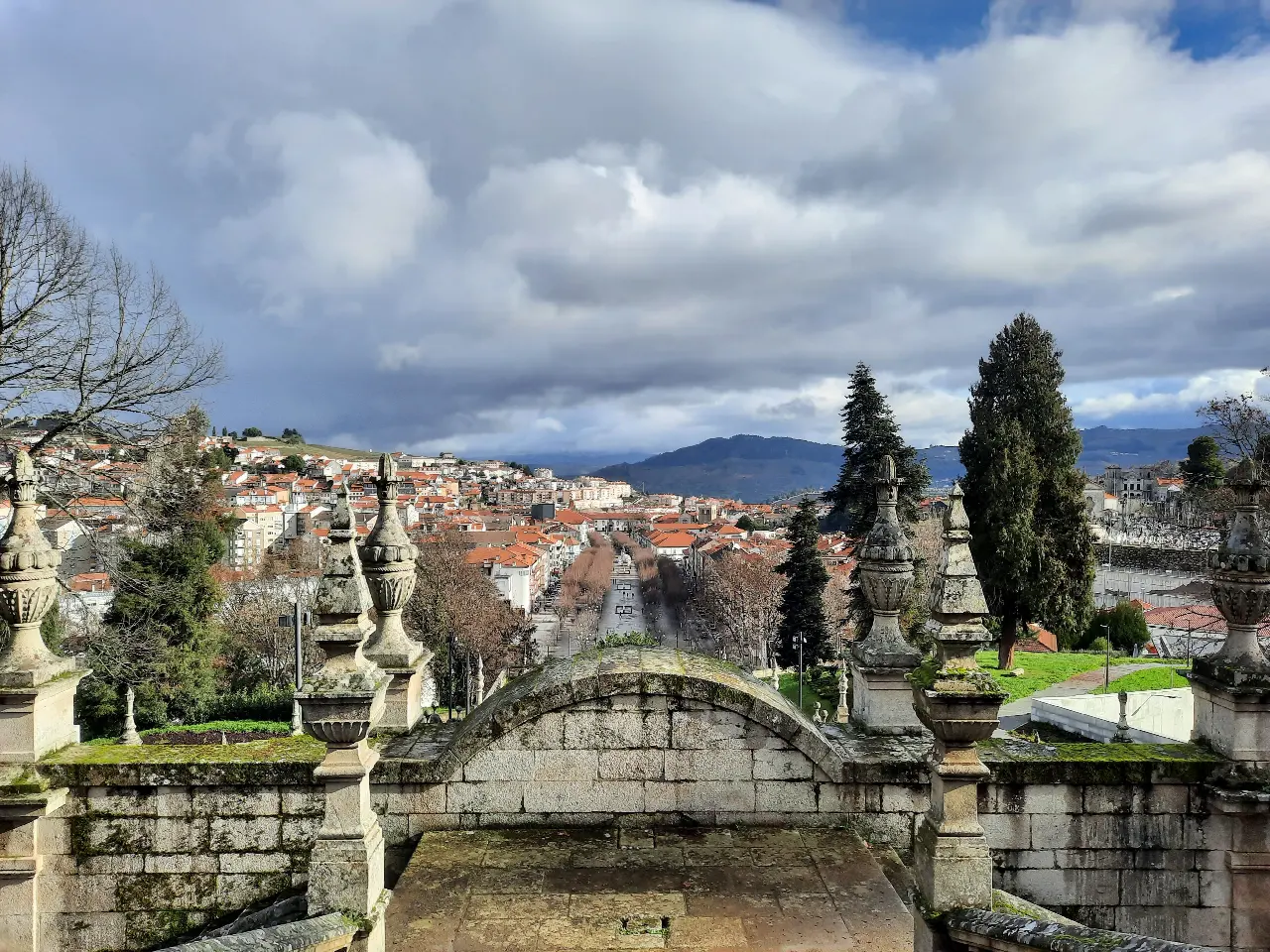
Where Is Lamego, and Why Is It Often Missed?
Lamego sits on the south bank of the Douro, about fifteen minutes' drive from Peso da Régua, in the western end of the wine region. That single geographic fact explains why so many travellers skip it: the Linha do Douro railway runs along the north bank, so Lamego has no station. Every train visitor who wants to see it has to get off at Régua and make a deliberate decision to cross the river. Most don't.
The result is a city of roughly 25,000 people that feels genuinely lived-in rather than staged for tourism. Cafés are full of locals at eleven in the morning. The Wednesday and Saturday markets are for buying vegetables, not souvenirs. If you have spent a few days in the more polished parts of the valley and want an afternoon that feels like ordinary northern Portugal, this is where to find it. Our guide to the Douro's wine sub-regions explains how this western corner of the valley differs from the drier country upstream.
The Sanctuary of Nossa Senhora dos Remédios and Its 686 Steps
This is the reason most people come, and it deserves its reputation. The Santuário de Nossa Senhora dos Remédios sits on a wooded hill above the city, and a monumental baroque staircase zigzags down from it in 686 steps, broken by landings, fountains, tiled panels and stone statues. It is Portugal's second-most famous devotional staircase after Bom Jesus do Monte in Braga, and while Braga's is more manicured, Lamego's is arguably the more dramatic arrival — the city spreads out beneath you the whole way down.
Construction began in 1750 and dragged on, in fits and starts, for more than 150 years, which is why the staircase and the church at the top do not quite feel like a single design. The church itself is comparatively plain inside; the staircase is the masterpiece. The blue and white azulejo panels, the Court of Kings terrace with its granite figures, and the granite obelisk are all worth slowing down for rather than powering past.
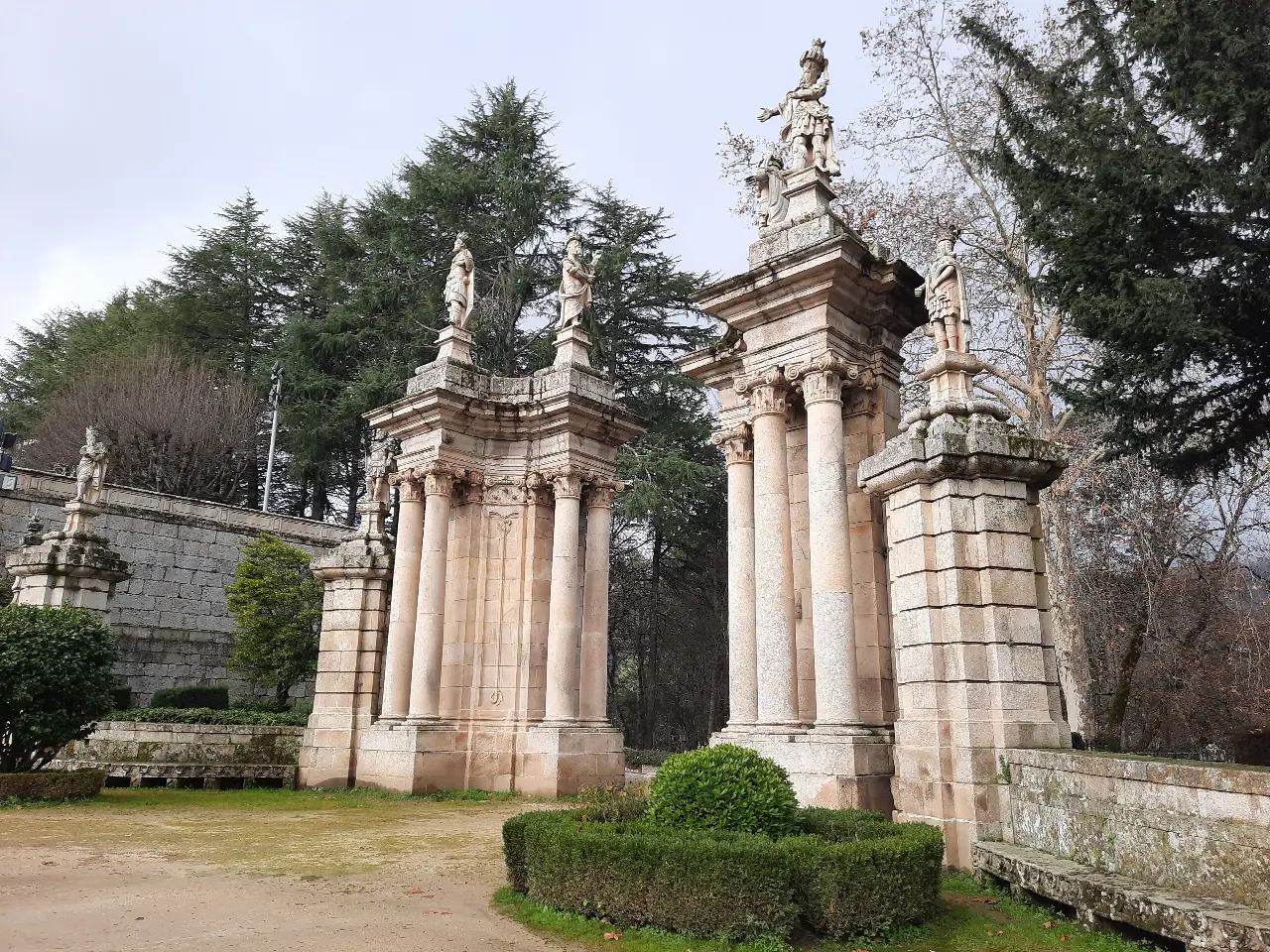
The practical advice everyone wants: you do not have to climb it. A road loops around the hill to a car park beside the church at the top, so drivers, and anyone travelling with people who would find 686 steps punishing, can start at the summit and walk down — which is the better direction for the views anyway, and leaves you in the city centre where the restaurants are. If you are walking up, allow 20 to 30 minutes at an unhurried pace and take water in summer. There is no entrance fee, and the grounds are open daily.
The sanctuary is also the focus of the Festas de Nossa Senhora dos Remédios, the biggest religious festival in the Douro, which fills the city in the first half of September and culminates around the feast day on 8 September. If your visit falls near those dates, read our full guide to the Festas dos Remédios before you book — accommodation across the whole area tightens considerably.
Lamego Cathedral and the Nasoni Ceiling
The Sé de Lamego was founded in the 12th century, and its square Romanesque bell tower is the oldest part still standing — the rest was substantially rebuilt across the 16th and 18th centuries. Walk in and look up. The painted ceiling is the work of Nicolau Nasoni, the Italian architect and painter who designed the Torre dos Clérigos in Porto, and it is a piece of full-blown baroque illusionism: flat plaster painted to read as soaring architecture opening onto sky.
Entry is free. Give it twenty minutes, and step into the adjoining cloister, which is calm, green and almost always empty. The cathedral sits at the foot of the sanctuary staircase, so the two pair naturally in a single walk.
Lamego Castle
Uphill from the cathedral, through a knot of narrow lanes that repay getting slightly lost in, is the Castelo de Lamego — a 12th-century keep and a surviving stretch of wall on the high point of the old town. It is free to enter, rarely busy, and the climb up the tower gives you the best rooftop-level view of the city that does not involve the sanctuary. There is also a striking vaulted medieval cistern nearby. The castle is run largely by local volunteers, so opening hours can be less predictable than a state monument's; if it matters to your plan, treat it as a bonus rather than a fixed appointment.
Museu de Lamego
If you only pay for one thing in Lamego, make it this. The Museu de Lamego occupies the former Bishops' Palace, an 18th-century building facing a shaded square, and it is far better than a city this size has any right to have. Admission is around €3.
The collection's two standouts are a set of 16th-century Flemish tapestries depicting the story of Oedipus — large, strange and beautifully preserved — and a group of painted panels from the workshop of Vasco Fernandes, the Renaissance master known as Grão Vasco. There are also chapels reconstructed inside the museum from a dissolved local convent, gilded woodwork removed and reassembled piece by piece. Allow an hour, more if you like painting. For a very different museum focused on the wine industry itself, the Douro Museum over in Régua is the natural companion visit.
São Pedro de Balsemão: One of Iberia's Oldest Churches
Three kilometres northeast of the centre, in a hamlet beside a stream, stands a small chapel that is widely described as the second-oldest church on the Iberian Peninsula. The Capela de São Pedro de Balsemão is believed to be Visigothic in origin, and its interior preserves genuinely rare early-medieval features — reused Corinthian columns, horseshoe-influenced arches, carved stonework and Mozarabic details of a kind that survive in almost no other Portuguese building. The tomb of Bishop Afonso Pires sits inside.
It is tiny, and it is not a spectacle in the way the sanctuary is; the point is its age and rarity. Entry is free. The walk out from Lamego is pleasant and mostly downhill through vineyards and a wooded river corridor, but check locally before setting off, as this is a small chapel with limited staffing and it is not reliably open all day.
Caves da Raposeira: Sparkling Wine, Not Port
Here is the thing that surprises visitors most: Lamego's signature drink is not Port. The city sits high enough and cool enough that in 1890 a sparkling wine industry took root here, and Raposeira became the name most Portuguese associate with celebration bottles. The Caves da Raposeira on the city's edge still produce by the traditional method — second fermentation in the bottle, exactly as in Champagne — and run guided tours through the cool underground cellars, ending in a tasting.
Tours are inexpensive by wine-tourism standards and genuinely informative about méthode traditionnelle production, which makes a refreshing change of pace if you have spent three days tasting fortified wine. Book ahead rather than turning up: tour times are limited and walk-in availability is unreliable. If you want the Port education instead, our guide to Port wine styles covers what to taste and where.
What to Eat in Lamego
Lamego is a serious food town, and its two specialities are worth planning a meal around.
Presunto de Lamego is the city's famous cured, lightly smoked ham, made from pigs raised in the surrounding hills and aged in the cold mountain air. It is sliced thin and eaten as it comes, usually with bread and a glass of red. It is good enough that the city is sometimes simply called the cidade do presunto.
Bôla de Lamego is the other one — a flat, savoury baked bread stuffed with that same presunto, or sometimes with other cured meats, sausage or cod. It is sold by weight in bakeries, eaten warm or cold, and is the single best picnic food in the Douro. Buy a wedge before you walk up to the castle.
Beyond those, expect the robust cooking of the interior north: roast kid, bacalhau in many forms, and hearty soups. Our round-up of ten essential Douro dishes covers the wider regional repertoire.
A Half-Day Walking Route
Everything central in Lamego is walkable, and the sights link together neatly in one loop if you take them in the right order. This is the version we'd suggest to someone arriving mid-morning with a single day.
Start at the top. Drive or take a taxi to the car park beside the sanctuary, look around the church and the terraces, then walk down the 686 steps — twenty unhurried minutes, with the city opening up in front of you the whole way. You arrive at the bottom in the Avenida, the broad tree-lined boulevard that runs into the centre.
From there the cathedral is a two-minute walk, and the museum faces a square immediately beside it. Do both, then climb the lanes behind the cathedral to the castle — it is steeper than it looks on a map, but short. Come back down for a late lunch of presunto and bôla, and finish at the Raposeira cellars in the afternoon if you booked a tour, or head out to Balsemão if you would rather have the quiet chapel than the wine.
Reverse the order if you are arriving by bus from Régua without a car: start in the centre, do the museum and cathedral first, climb the staircase in the cool of the late afternoon, and take a taxi back down.
How to Get to Lamego
By train and bus. There is no station in Lamego. Take the Linha do Douro to Peso da Régua — around 1 hour 55 minutes from Porto on Inter-Regional services — then cross the river by bus or taxi. Buses connect Régua and Lamego through the day, and a taxi costs roughly €15–25 and takes about fifteen minutes. Check return times before you commit to a late afternoon in the city, because evening connections thin out. Our guide to visiting the Douro without a car goes into the regional transport picture in detail.
By car. From Porto, allow about 1 hour 30 minutes via the A4 and A24. From Régua it is a short, well-signposted drive across the bridge. Parking is straightforward by Douro standards — there is a car park at the top of the sanctuary hill and paid parking in the centre.
As a day trip. Lamego works well bolted onto a Douro day, though organised tours from Porto rarely include it. If you are weighing up how to structure a single day in the valley, our comparison of Porto-to-Douro day trip options lays out the trade-offs, and our complete transport guide covers every route into the region.
How Long to Stay, and Where
Three to four hours covers the sanctuary, the cathedral, the castle and the museum at a civilised pace. Add the Raposeira cellars and a proper lunch and you have a comfortable full day. Add Balsemão and you are into a second morning.
Staying overnight is the underrated option. Lamego is markedly cheaper than Pinhão or Régua for the same standard of room, it has actual restaurants open in the evening rather than hotel dining rooms, and it puts you within half an hour of the western quintas. The trade-off is that you are further from the classic terraced river scenery upstream. Our guide to accommodation in Lamego covers the options, and if you are still deciding on a base, Pinhão versus Régua sets out how the north-bank towns compare.
When to Visit
Spring and early autumn are the sweet spots, as they are across the region — warm enough for the walking that Lamego demands, without the July and August heat that makes 686 steps a genuine ordeal. September brings both the harvest and the Remédios festival, which is either exactly what you want or exactly what you want to avoid, depending on your tolerance for crowds. Winter is cold and quiet, and the city carries it well. Our seasonal guide to the Douro breaks the year down month by month.
Frequently Asked Questions
How many steps does the Lamego staircase have?
The baroque staircase at the Santuário de Nossa Senhora dos Remédios has 686 steps, climbing the hillside in a series of zigzagging flights broken by landings, fountains and tiled panels. You can avoid the climb entirely by driving to the car park beside the church at the top and walking down instead.
Is Lamego worth visiting?
Yes, particularly if you want history rather than more vineyards. In half a day you can see one of Portugal's great baroque staircases, a cathedral with a Nasoni-painted ceiling, a free medieval castle and an excellent regional museum — and it is far less visited than the north-bank wine towns, so none of it feels crowded.
Can you visit Lamego by train?
Not directly. Lamego has no railway station, because the Douro line runs along the opposite bank of the river. Take the train to Peso da Régua and cross by bus or taxi, which takes about fifteen minutes. Check the return times before you set off, as evening services are limited.
Is Lamego a good base for the Douro Valley?
It is a good-value one. Rooms are typically cheaper than in Pinhão or Peso da Régua, the city has a genuine evening restaurant scene, and the western quintas are within easy reach. The compromise is distance from the dramatic terraced landscapes further upstream, so it suits travellers who want a real town to come back to more than a vineyard view from the window.